

A previous article introduced behavioral analysis for legal-AI using Anthropic’s 5-series models (Sonnet-5, Opus-5, Fable-5). Around the time that article was published, Anthropic released Fable 5.1, Meta released Muse Spark 1.3, Google released Gemini 3.8 Flash, and OpenAI released GPT-6 Astra. This article reports the observed behaviors of two of those newer-generation models, Fable 5.1 and GPT-6 Astra, when run on the Legora Bar Tax Case.1 Behavioral analysis has also been run on Muse 1.3, Grok 4.6, and Gemini 3.8, which will be reported in future articles.
Behavioral analysis uses the transcripts and trajectories of AI sessions to examine how particular tasks are agentically performed. The reasoning, commands, tool calls, file operations, and other actions exhibited during a session are used to identify characteristic behaviors, such as workflow organization, source selection and review, factual verification, conflict handling, adaptation, and draft construction and revision. These characteristics are used to define each session’s behavioral profile. Once defined, the profiles are compared to identify recurring behaviors and differences associated with particular models, effort settings, harnesses, and skills.
The Legora Bar Tax Case was selected because it presents a realistic and relatively complex legal task of drafting a transfer-pricing master file from a seventy-two-document matter file according to a supplied template. This task requires models to access and review a sizable record of heterogeneous documents, including flattened PDFs of authentic financial filings. Models must then draft to a template containing non-text artifacts, including images of flowcharts. Beyond the tax-specific transfer-pricing analysis, these features expose behaviors involving parsing, optical character recognition (OCR), context, and embedded non-text artifacts.
The following sessions are examined in this article:

The analysis below examines how Fable 5.1 and GPT-6 Astra approached the Legora Bar Tax Case, including source preparation and review, conflict handling, analysis, verification, and document production. The discussion then compares their behaviors and assesses each model’s strengths and weaknesses.
Methods: Task Execution and Behavioral Analysis
Five models were run across available High, Xhigh, and Max effort settings, producing twelve model/effort sessions. Each model/effort combination was run in its corresponding harness: Fable 5.1 in Claude Code, GPT-6 Astra in Codex, Muse 1.3 in Muse Code, Grok 4.6 in Grok Build, Gemini 3.8 in Antigravity.
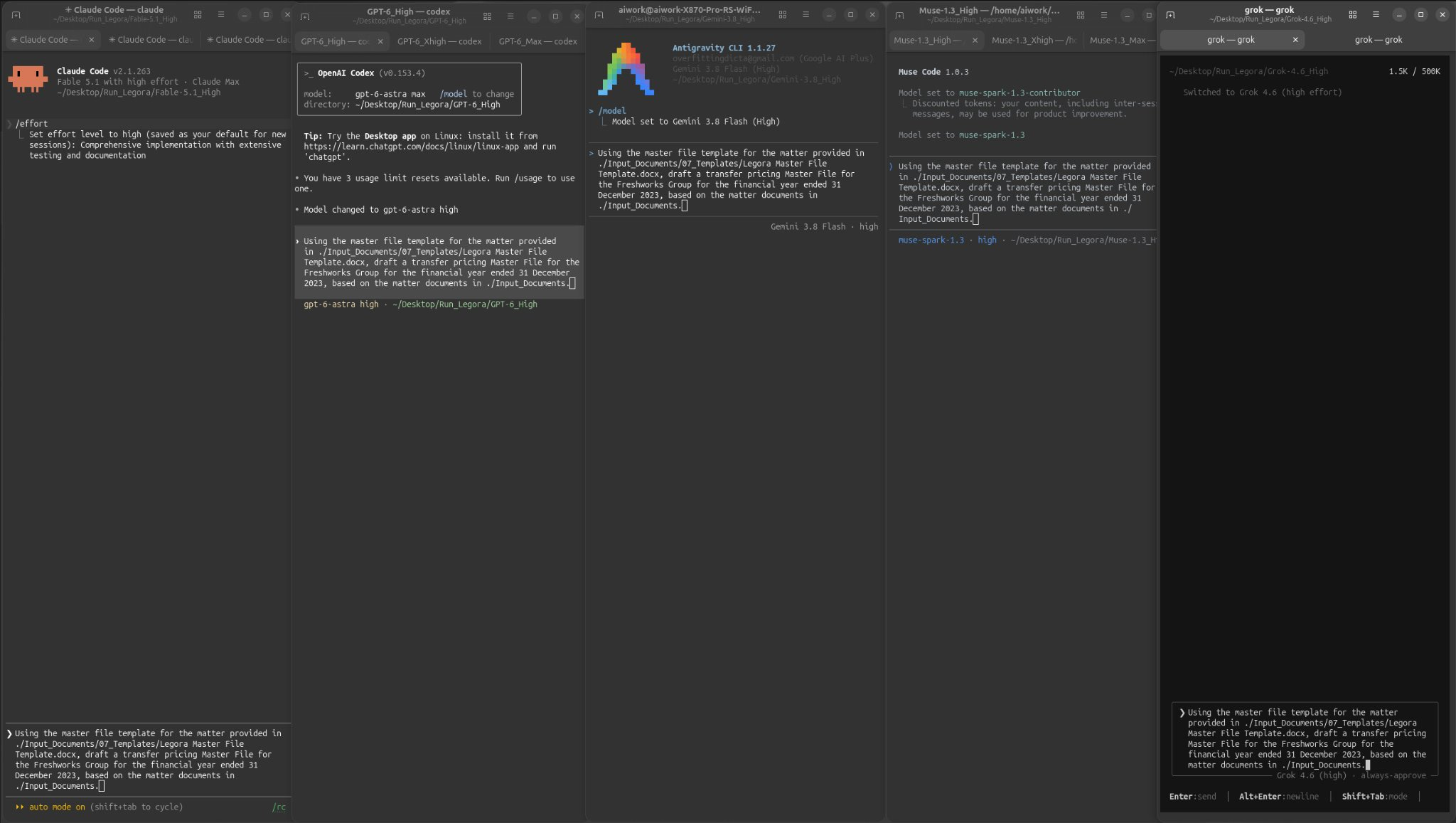
Each run began in a fresh harness session with its own working directory containing the same Legora Bar Tax Case files at the same relative paths. Every session received the same prompt:
“Using the master file template for the matter provided in ./Input_Documents/07_Templates/Legora Master File Template.docx, draft a transfer pricing Master File for the Freshworks Group for the financial year ended 31 December 2023, based on the matter documents in ./Input_Documents.”
With the exception of Gemini 3.8,2 both transcript and trajectory records were collected from each session for behavioral analysis.
Behavioral analysis proceeded with the methodology introduced in Introducing Behavioral Analysis for Legal-AI. Behavioral characteristics were identified from session transcripts and available trajectories to construct twelve individual-session behavioral profiles. For models run at multiple effort settings (Fable 5.1, GPT-6 Astra, Muse 1.3, and Grok 4.6), the session profiles were compared to construct model-on-task profiles describing “Recurring Observable Behavior” and “Material Behavioral Differences” across efforts.
Results: Behavioral Profiles of Fable 5.1 and GPT-6 Astra
The following results summarize behaviors identified in the session profiles for each model. Recurring behaviors describe common patterns within each model, while material differences identify where its sessions took different approaches. Individual-session profiles provide further detail for each model/effort combination.
In the below profiles, recurring behaviors are indicated by the letter “G.” Material differences are occasionally discussed and indicated by the letter “H.” Additionally, for each session, the most characteristic session or sessions profiles are provided as examples indicated by the letters “P” or “C.”
Full behavioral profiles for Fable 5.1 and GPT-6 Astra are available on GitHub.
Fable 5.1
Fable 5.1 approached the Legora Bar Tax Case as an ongoing matter instead of a single task. It assembled a broad record of the source materials, then proceeded on provisional positions that were continually tested and revised. Analysis and drafting were performed concurrently through an iterative process of revisions, source checks, calculations, and follow-up review. However, formatting appeared to have consumed excessive effort through failed generations, layout adjustments, iterative revisions, and repeated repairs. Generated transfer pricing Master File outputs were provided in both Microsoft Word and PDF formats, while preserving unresolved issues for attorney review. Finally, Fable 5.1 focused on preparing the case for continued analysis by compiling background knowledge of the case file and preserving that knowledge for future work.
Source Preparation and Review
Fable 5.1 expended substantial effort assembling, parsing, and preparing a broad local document corpus of the source materials.

Fable converted mixed document formats (including PDF, Word, Excel, and PowerPoint files) into searchable text, including through OCR of flattened PDFs. The conversions were imperfect, and all three runs encountered processing failures that required changes to the extraction procedure. These included missing OCR output, missing-style errors, incompatible XML, and other document-processing failures.

For example, at High effort, Fable 5.1 reported that OCR completed successfully but failed to produce the French text file. Fable 5.1 then inspected the log, changed the OCR setting, reran the process, and recovered the sought passage.

From this working corpus, Fable reviewed substantial portions of the source materials and used targeted searches and selected passages to locate particular facts.
Conflict Handling
Where sources conflicted, Fable 5.1 provisionally selected contemporaneous FY2023 records as its working baseline over a later interview describing different arrangements.

For example, at Xhigh effort, Fable 5.1 replaced the ledger’s GBP 4,181,519 total-debtors figure with the narrower GBP 2,814,321 group-receivable figure after reviewing the underlying UK account note.

Drafting proceeded from that provisional resolution, while later source review remained capable of changing individual factual positions.
Analysis and Verification
Fable 5.1’s iterative drafting process also involved repeated calculation and verification of underlying details, including comparisons of financial figures across sources.

One of the clearest inter-effort differences was the more extensive analysis and verification visible at Xhigh and Max.

For example, at High effort, Fable 5.1 continued checking sources, changed amounts, and narrowed factual assertions as drafting progressed.

Meanwhile, at Xhigh effort, Fable 5.1 independently recomputed inter-company charges from cost bases, mark-ups, and exchange-rate inputs.

At Max effort, Fable 5.1 performed a similar inter-company analysis.
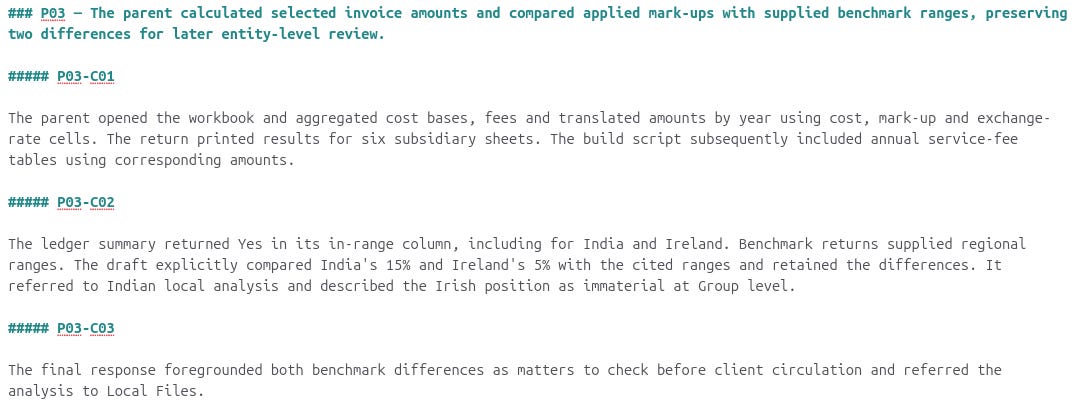
This independent verification at Xhigh and Max represents a marked difference from High’s greater reliance on retrieved ledger values and subsequent targeted revisions. Consistent with previous analyses, Fable (5 and 5.1) appears to be underpowered at lower efforts (e.g., High) and more rigorous at higher efforts (e.g., Max). The advantage of more rigorous analysis probably depends on the task. For example, should drafting a transfer-pricing Master File include recalculating inter-company financials?
Document Construction and Formatting
Much of Fable 5.1’s recorded effort also went into constructing and revising the document’s formatting. It wrote scripts to populate the supplied Legora template and generate figures, rendered the resulting file, and then repeatedly repaired formatting issues such as overflowing labels, wrapped table headers, paragraph flow, page breaks, and other layout defects.

At Max effort, for example, Fable 5.1 first failed to generate the appropriate format, then repeatedly adjusted layouts, tables, fonts, page breaks, and headings before reaching a stable result.
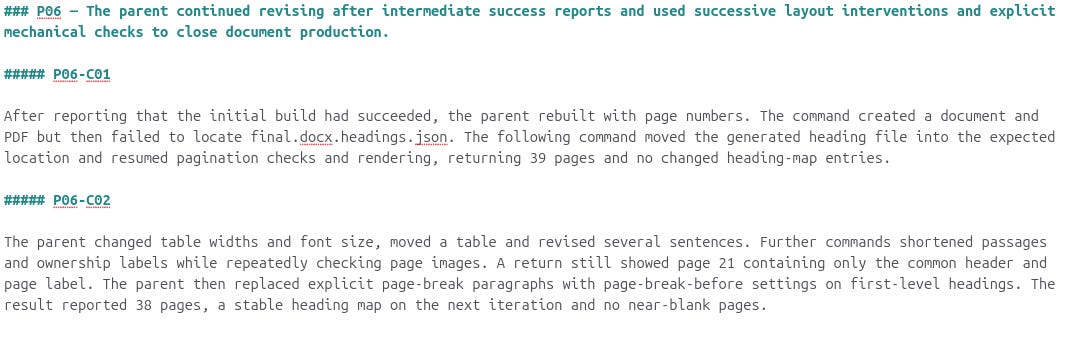
The amount of effort devoted to formatting appears excessive. A more efficient workflow might have Fable 5.1 produce the substantive analysis in Markdown or JSON, with a lower-cost model handling document formatting.
Output and Reviewer Handoff
Fable 5.1 continued checking sources through draft completion, while also surfacing unresolved issues for attorney review.
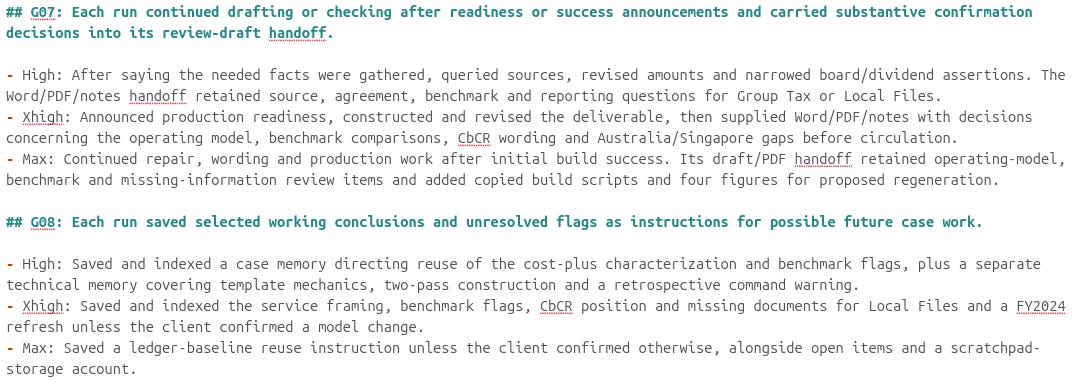
For example, at Xhigh effort, Fable 5.1 provided drafting notes that flagged analytical decisions for attorney review.

Multi-Task Continuity (Fable Specific)
An additional behavior specific to Fable 5.1 was preparing for continued work on the same matter beyond the immediate task. (See image of G08 above.)

At Max effort, for example, Fable 5.1 preserved matter knowledge by generating instructions and memories and flagging additional issues identified in the source materials. Such continuity could be useful for complex matters involving continuing analysis and accumulated matter knowledge, but may reduce efficiency for simple one-off tasks.
GPT-6 Astra
GPT-6 Astra (“Astra”) treated the source materials as a limitation by organizing the task around available evidence. Unfortunately, this led to an incomplete analysis because it failed to parse all of the source materials. Drafting proceeded based on this incomplete record. Meanwhile, Astra continued to parse and review additional documents, verify information, and perform calculations. The draft’s content and conclusions were then revised and qualified based on additional information recovered through continuing review. Generated transfer pricing Master File outputs were provided in Microsoft Word format at High effort and in both Microsoft Word and PDF format at Xhigh and Max efforts. In addition to substantive analysis and conclusions, the generated outputs surfaced unresolved issues for attorney review, including as requests for additional information and questions for confirmation. One particularly concerning behavior was the tendency for post-drafting review to strengthen conclusions without new support.
Source Preparation and Review
The Legora Bar Tax Case includes difficult documents that Astra struggled to extract and review across mixed file formats. All three sessions encountered parsing or extraction problems and used multiple methods to recover usable text. Astra repaired missing styles or unusual spreadsheet cells and turned to more complex OCR processes when PDF extraction yielded little usable text. Some sessions also attempted to review extraction files before processing had completed.
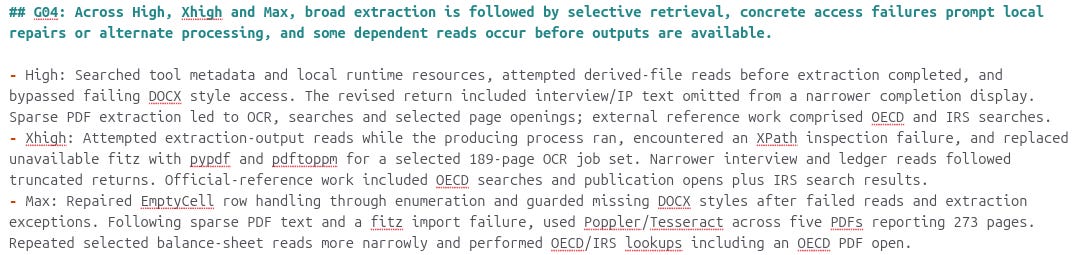
For example, at High effort, Astra encountered missing-file and style errors while processing particular documents.
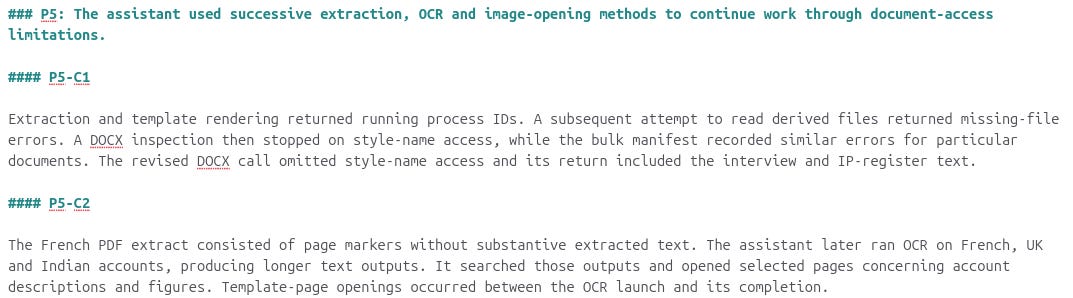
As with Fable 5.1, Astra required multiple attempts to recover French text. Ultimately, Astra recovered enough material to continue the analysis, although its review of the source record remained incomplete.
Conflict Handling
One of Astra’s strengths was its explicit identification and reconciliation of conflicting information. Across all sessions, Astra considered both contemporaneous FY2023 records and later FY2024 disclosures, specifically identified source conflicts, and treated the contemporaneous FY2023 records as controlling when reconciling the later disclosures.
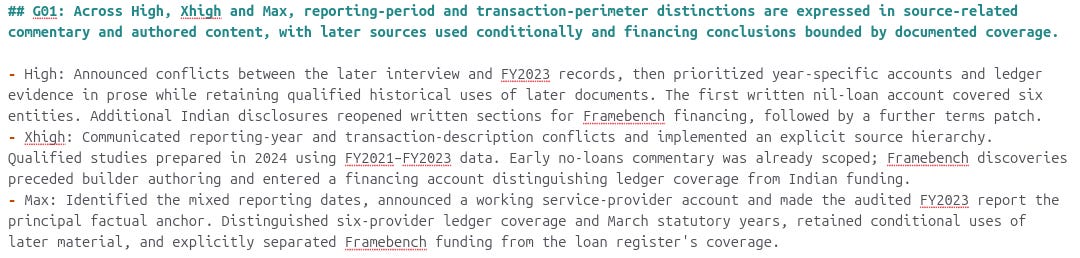
At High effort, for example, Astra checked the service and financing arrangements described in the later interview against the FY2023 ledger and entity accounts.
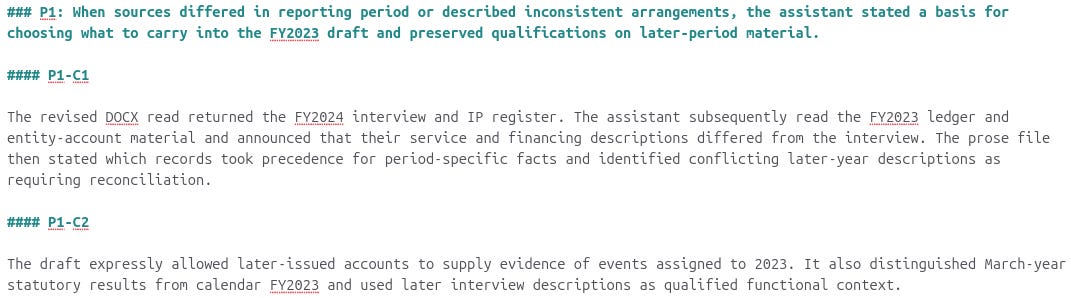
During drafting, this reconciliation continued through appended information, revisions, and patches.
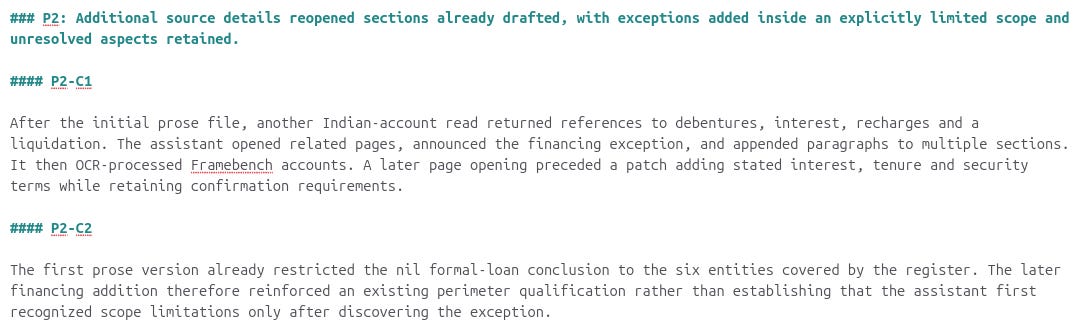
Astra carried those qualifications into the work product handed off for attorney review.
Analysis and Verification
Like Fable 5.1, Astra independently recomputed and checked some financial information. Consistent with its treatment of conflicting evidence, Astra also distinguished between what its calculations established and what remained unresolved.
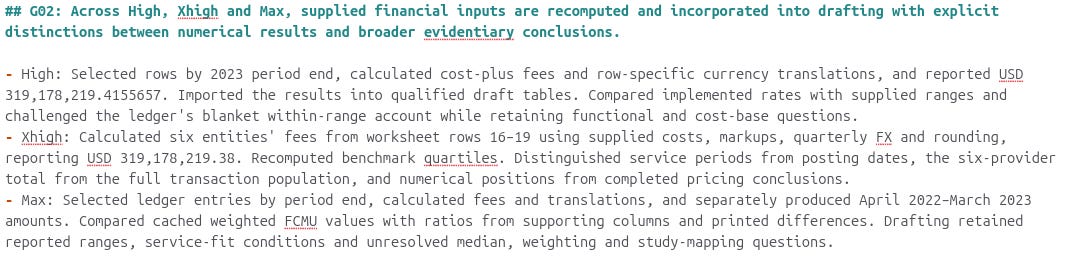
At Max effort, for example, Astra recomputed financial figures from the supplied inputs and separately identified questions that the calculations themselves could not resolve.

Document Construction and Formatting
All Astra runs followed the Legora Bar template closely, preserving its structure while populating and revising the document through targeted drafting and formatting changes.
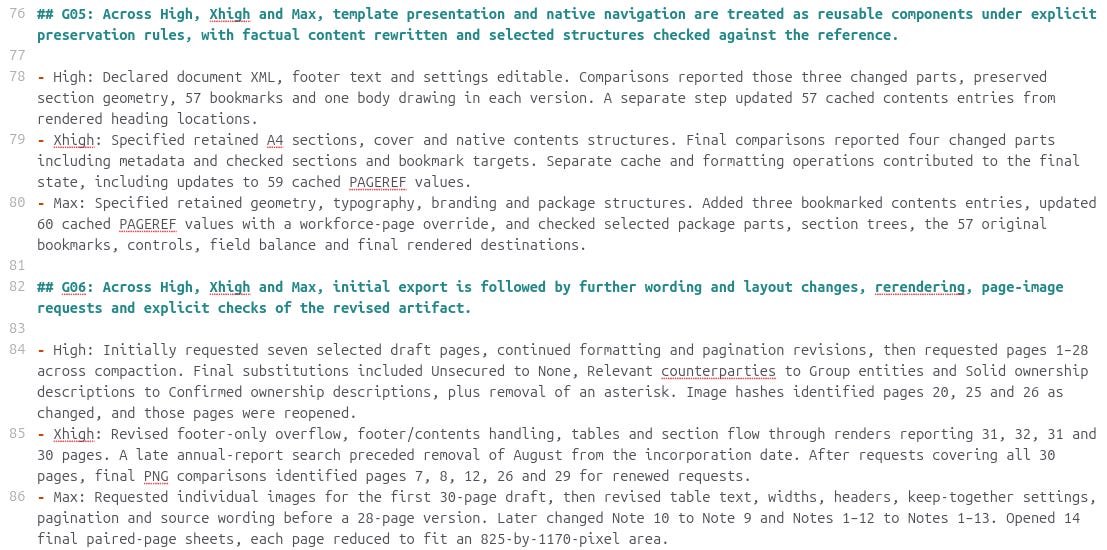
At Xhigh effort, for example, Astra revised specific template pages, rendered the document, and used those renders to identify further formatting corrections.
Output and Reviewer Handoff
Following drafting, Astra flagged unresolved issues for attorney review.
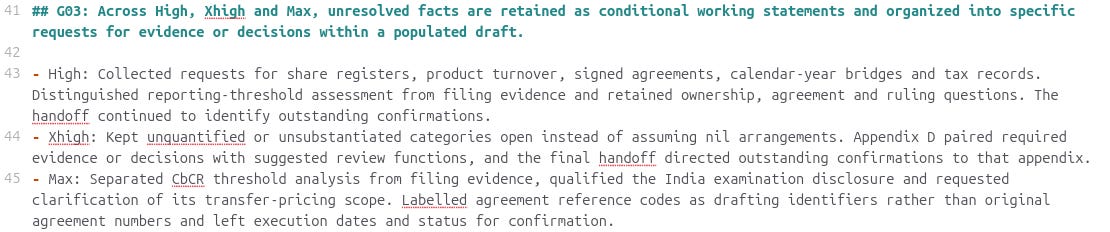
At Xhigh effort, for example, it identified unsupported or missing information and specified the records, confirmations, and additional review needed to resolve those issues.
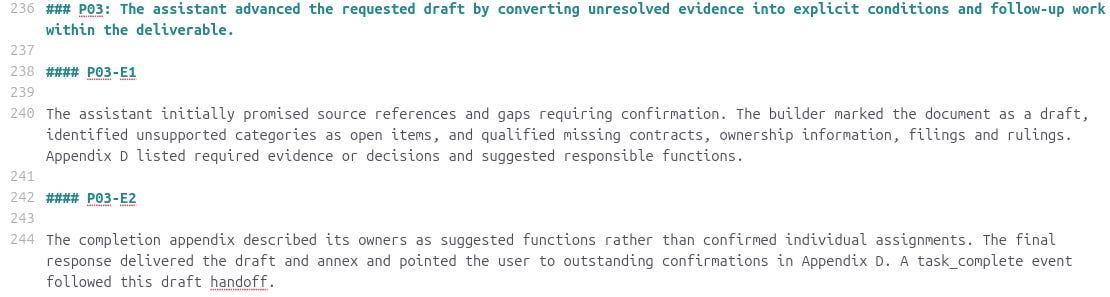
Astra also preserved supporting materials, including calculations, source extracts, and construction notes.
Context Compaction (Astra Specific)
All three Astra sessions crossed a compaction boundary during document construction and drafting. In these runs, Codex reported an effective context window of 258,400 tokens.

Future analysis should examine whether a larger context configuration changes Astra’s behavior or resulting work product.
Discussion: Comparing the Behavior of Fable 5.1 and GPT-6 Astra
The behaviors observed in the Legora Bar Tax Case suggest that Fable 5.1 and GPT-6 Astra are suited to different legal tasks and analyses. Fable 5.1 assembled a broader record, revised provisional positions, and prepared the matter to continue. Meanwhile, Astra organized the work around the template and the evidence it could parse.
First, the Legora Bar Tax Case required reviewing a sizable corpus of mixed-format documents. Fable 5.1 was better able to work through this corpus, proceeding on provisional positions that it revisited as review continued. In contrast, Astra struggled with parsing and ultimately proceeded on an incomplete record. Astra likely would have benefited from receiving a parsed corpus that has been screened for relevance and completeness. These behaviors suggest that Fable 5.1 may be better suited to document review, record development, and continuing analysis.
Second, both models performed substantive analysis and financial verification, but each faced a different limitation. Astra’s analysis may have been hindered by its incomplete record, while Fable 5.1 appeared underpowered at High effort. More extensive analysis and verification at Xhigh and Max provide further evidence that Fable (5 and 5.1) may perform more detailed and rigorous analysis at higher effort settings.
Third, Astra was better able to populate the supplied drafting template while preserving its structure. Fable 5.1 struggled to conform to the template’s layout and formatting, expending excessive effort on repeated adjustments and repairs. Thus, Astra may be better suited to discrete tasks where source materials are easily parsable, particularly where a template or other convention dictates the output’s structure.
Finally, both models presented unresolved issues for attorney review. Astra also exhibited a problematic tendency to strengthen conclusions during post-drafting review without new supporting evidence. Beyond these observed behaviors, the relative quality of the completed outputs is better assessed through direct comparison and grading.
This analysis is for educational and informational purposes only. It is not legal, financial, or other professional advice and does not create an attorney-client or any other professional relationship. The analysis is based solely on publicly available information. Any views expressed are solely those of the author in the author’s individual capacity.
The Legora Bar Tax Case was accessed on July 29, 2026, at https://github.com/legora-oss/legora-bar-tax-case (commit f5032cb) under the open source Apache-2.0 license. The author is not affiliated with Legora, Anthropic, OpenAI, or any AI entity. This article is derived from the author’s own efforts to build, evaluate, and improve AI pipelines for legal analysis.
Behavioral analysis of Gemini 3.8 is based on its transcript alone because a trajectory could not be exported or saved.