

AI is typically assessed on its results. Legal AI fixates on memos, contract redlines, and other generated outputs because those are what a reviewing attorney sees. Most commonly, such outputs are judged against a rubric of scoring criteria or a sample answer, or compared pairwise against other AI-generated outputs. Results, however, are generated at the end of an analysis involving workflow structure, research methods, verification, adaptation, draft assembly, review strategies, and revision procedures. Cumulatively, these processes define a behavioral profile, and that profile is arguably more informative for assessing and improving legal AI than the result it produced.
Behavioral analysis uses the trajectory records of AI sessions to reconstruct their behavioral profiles. Every agentic session produces a trajectory, a recorded event log of the AI’s processes in pursuing a specific task. The trajectory of a legal agent might specify which case documents were reviewed in what order, how important facts were verified, how conflicting information was resolved, and how results were drafted, reviewed, and revised. Compared across multiple sessions, these processes reveal which behaviors are characteristic of a model and how they are affected by effort level and skills. Additionally, if certain behaviors are associated with superior analysis, behavioral analysis can help identify the configuration best suited to a particular legal task.
AI users are familiar with session transcripts. When a model runs in a chat interface or an agent runs in a harness, the session transcript displays a running stream of actions, including reasoning (i.e. thinking), commands, tool calls, and other processes. The screenshot below shows the transcript of a Claude.ai chat session in which Sonnet 5 at max effort ran a modified version1 of the build-litigation-case-timeline task from Harvey’s Legal Agent Benchmark (LAB), an open-source repository of synthetic legal tasks.2 As detailed in a previous Benchmarking Claude for Legal article, that task supplies a fifteen-document record for a fictional breach of contract dispute and asks the model to build a litigation case timeline with strategic annotations for summary judgment preparation.
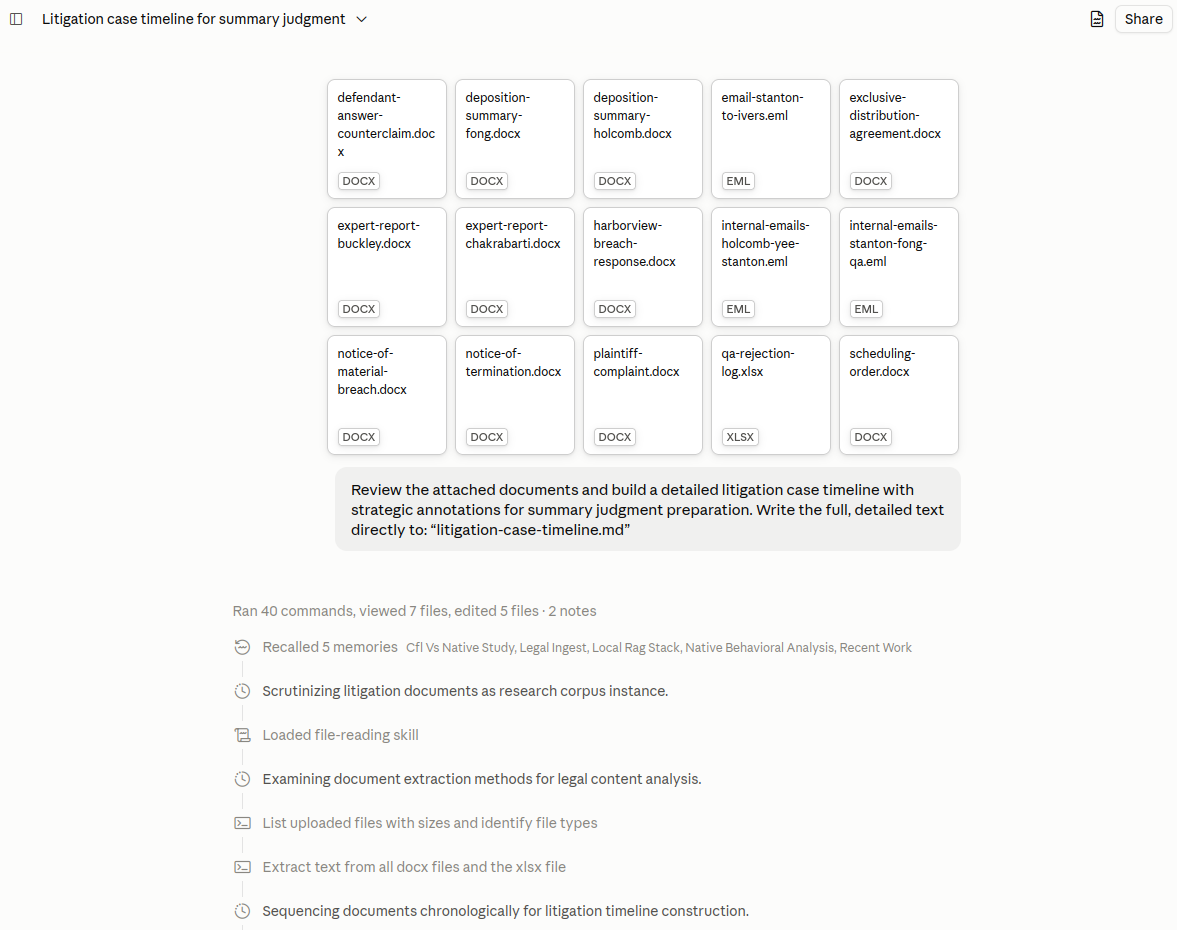
When run in the Claude.ai web interface, Sonnet-5_Max ran 40 commands, viewed 7 files, and edited 5 files. The session transcript provides a running narration of the actions Sonnet-5_Max executed, beginning with “Scrutinizing litigation documents,” “Examining document extraction methods,” and “Sequencing documents chronologically.”
When Sonnet-5_Max runs the same task in Claude Code, a session transcript is displayed by the terminal. For example, the left half of the image below shows Sonnet-5_Max beginning the build-litigation-case-timeline task by “exploring the documents directory to see what’s available for review.”
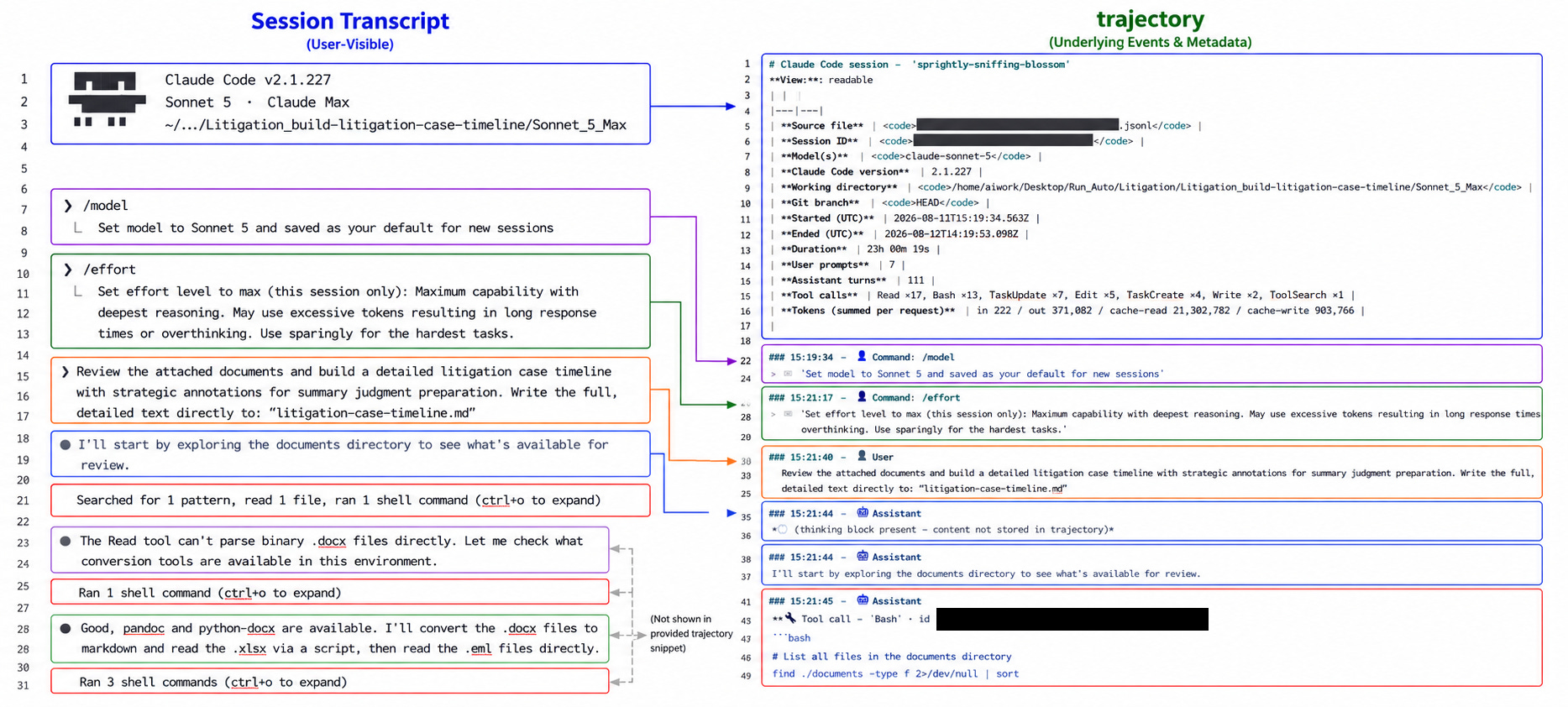
Apart from displaying the session transcript, Claude Code also records a trajectory for each session. The above image compares the session transcript (left) and trajectory (right) for the same Sonnet-5_Max session, with annotations indicating corresponding entries. For example, both include the “I’ll start by exploring the documents directory to see what’s available for review” action (annotated in blue). Then, where the transcript mentions running “1 shell command,” the trajectory identifies that command as “fin ./documents -type f 2>/dev/null | sort” (annotated in red). The transcript summarizes what the model did, while the trajectory records the specific actions it took.
Session trajectories may be decomposed into behavioral characteristics. For example, a behavioral profile of Sonnet-5_Max on the build-litigation-case-timeline task identifies characteristic P1 from the model’s response to being unable to parse .docx files directly: it checked what conversion tools were available and converted the documents to markdown with pandoc.
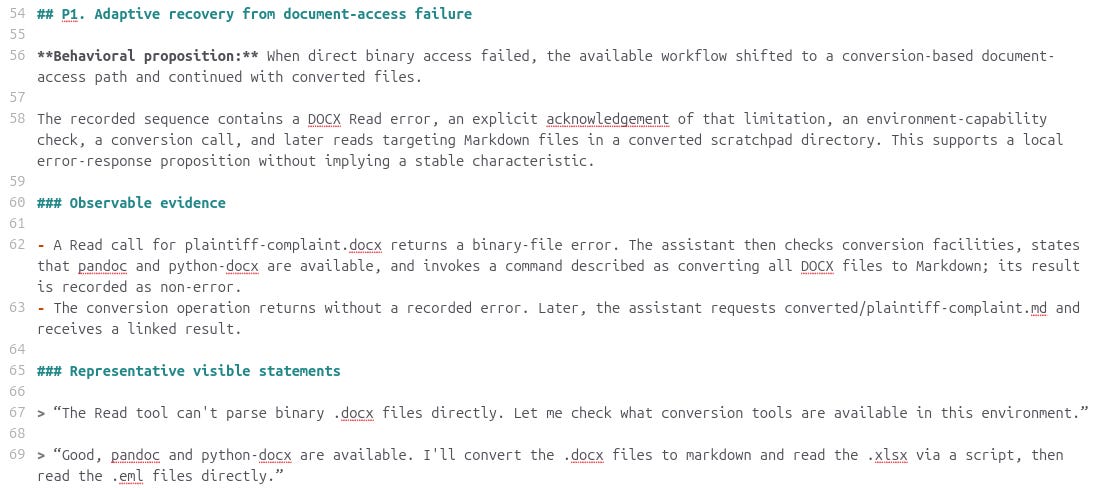
Considered as a whole, a session’s cumulative behavioral characteristics define its behavioral profile.
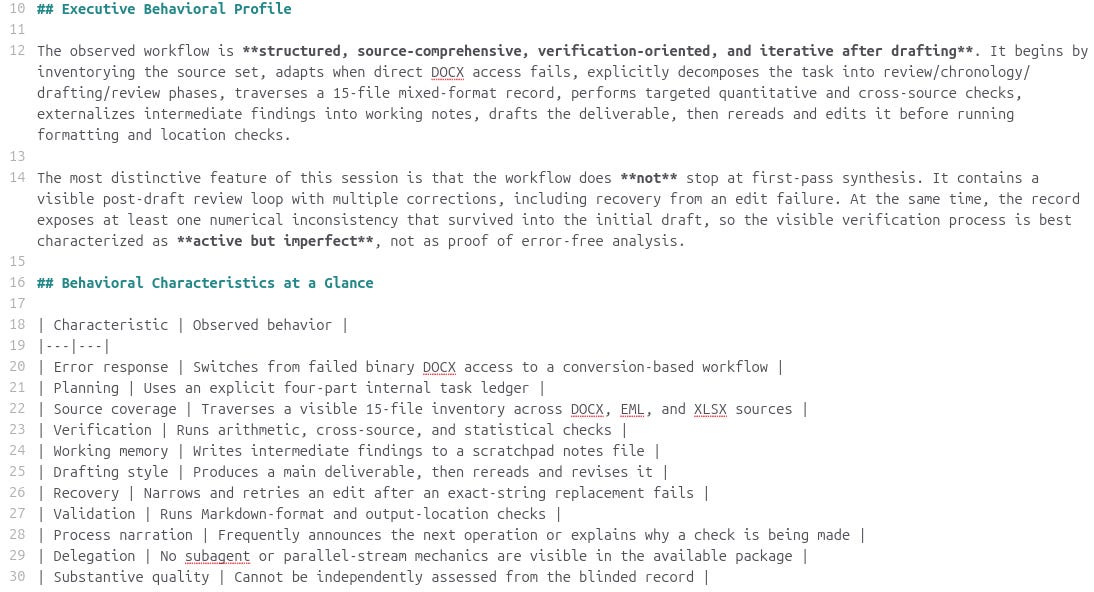
Here, the Sonnet-5_Max trajectory decomposes into eleven characteristics, which are summarized in the table and compiled in the executive profile above. Individual session profiles are then evaluated as part of a broader behavioral analysis.
Methods: Tiered Behavioral Analysis
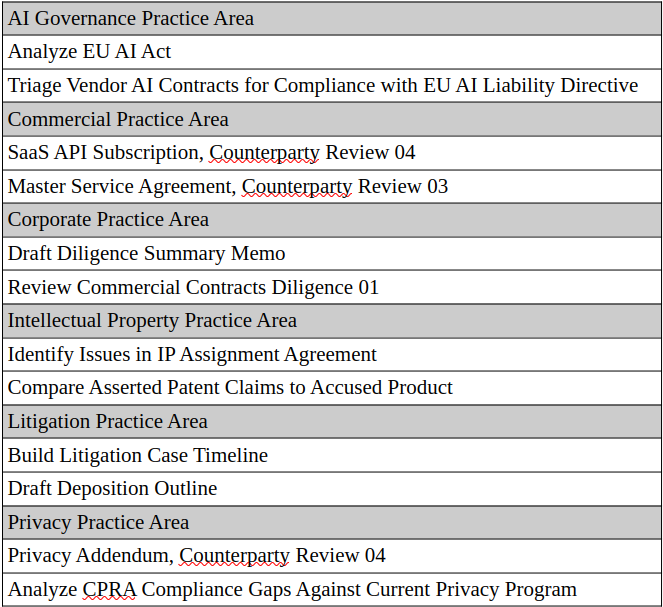
This article analyzes the behavior of three Anthropic models (Fable-5, Opus-5, and Sonnet-5) on the twelve Harvey LAB tasks set forth in a previous Twelve-Task Claude-for-Legal Benchmark.3 The tasks span six practice areas, two per area, and serve here as a native baseline for the Claude for Legal (CfL) skill comparison reserved for a subsequent article.
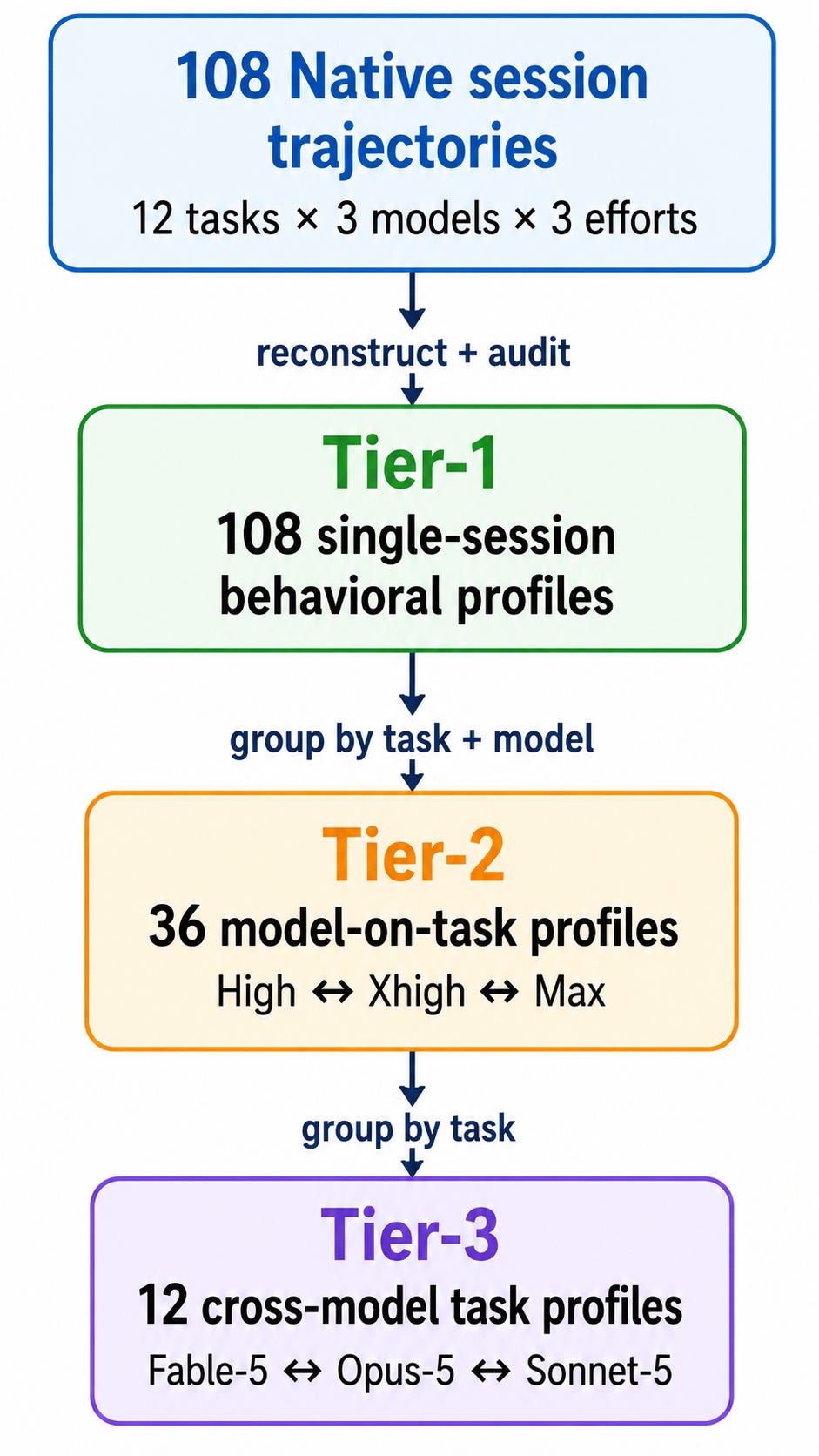
Each model ran each task once at each of three effort levels (High, Xhigh, and Max), producing 108 sessions (12 tasks × 3 models × 3 efforts). The analysis of those sessions proceeded through three tiers. The first tier (C1) constructed 108 session behavioral profiles by analyzing the session trajectory of each model/task/effort combination. The second tier (C2) constructed 36 model-on-task behavioral profiles by comparing session behaviors for each model/task combination across High, Xhigh, and Max. The third tier (C3) constructed 12 cross-model task profiles by comparing model behaviors for each task across Fable-5, Opus-5, and Sonnet-5.
The first tier constructed session behavioral profiles from observable behavioral characteristics in each sessions trajectory. The Sonnet-5_Max build-litigation-case-timeline profile shown above illustrates the first tier. It was constructed from eleven observable characteristics, including the adaptive recovery from a document-access failure characteristic (P1).
The second analysis tier constructed model-on-task behavioral profiles from each model’s three session profiles on a task at High, Xhigh, and Max efforts. Below, the Sonnet-5 profile on the build-litigation-case-timeline task illustrates this analysis. Its behavioral overview identifies the behaviors common to the three Sonnet-5 sessions and how those behaviors differed by session.

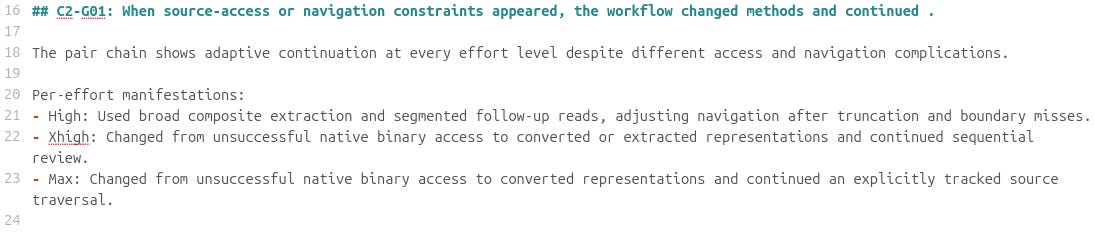
A behavior observed in all three sessions was recorded as a recurring behavior of the model on that task. For example, all three Sonnet-5 sessions changed their source extraction method after failing to access the source documents directly.
Conversely, where a behavior varied by session, the variation was recorded as a behavioral difference. Although every Sonnet-5 session changed how it accessed the source materials, the adopted extraction and review methods differed.
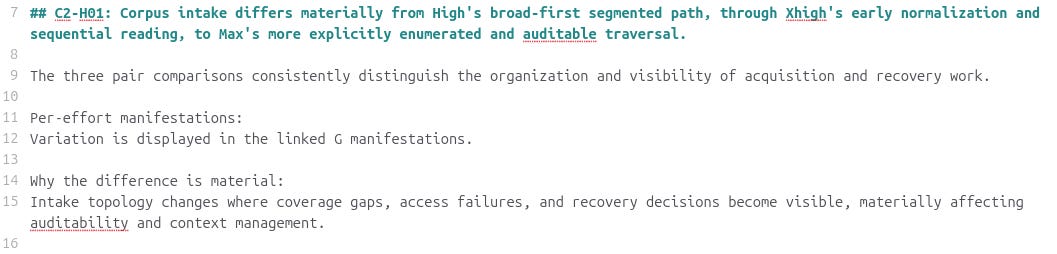
Here, the session-level variation in extraction and review methods is detailed in the manifestations of the C2-G01 characteristic. Sonnet-5_High adapted with composite extraction of the source materials and segmented follow-up reads. Sonnet-5_Max converted the source documents to a readable format, then tracked its traversal of the converted documents. Meanwhile, Sonnet-5_Xhigh adopted a hybrid conversion or extraction behavior with sequential review. Each session’s behavioral profile supplies further detail. For example, Sonnet-5_Max’s adaptive recovery from a document-access failure characteristic (P1) provides that the session “convert[ed] all DOCX files to Markdown.”
The third analysis tier constructed task-level behavioral profiles from each task’s three model-on-task profiles (Fable-5, Opus-5, and Sonnet-5). Below, the build-litigation-case-timeline task profile illustrates this analysis. Its behavioral overview identifies the behaviors common to the three models and how those behaviors differed by model.
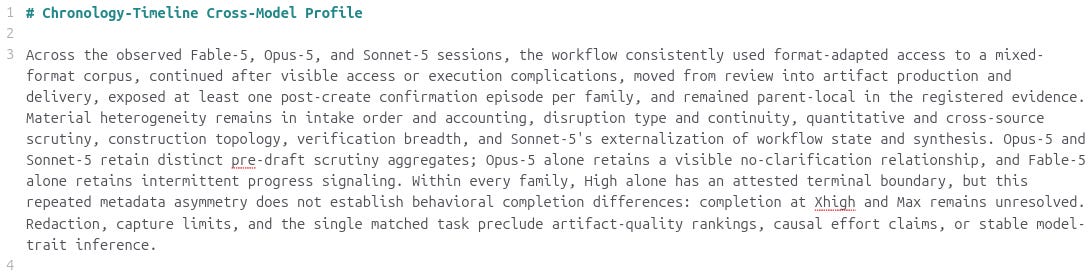
As at the second tier, a behavior observed in all three models was recorded as a recurring behavior on that task. For example, all three models adapted their access methods to the source documents of the build-litigation-case-timeline task.
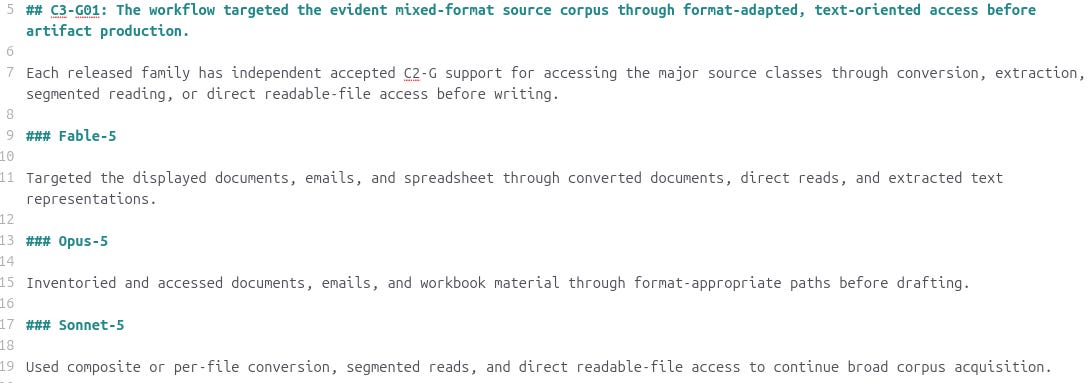
Model-level behavioral differences were likewise recorded by task. For example, the extraction and review methods adopted by each model differed.
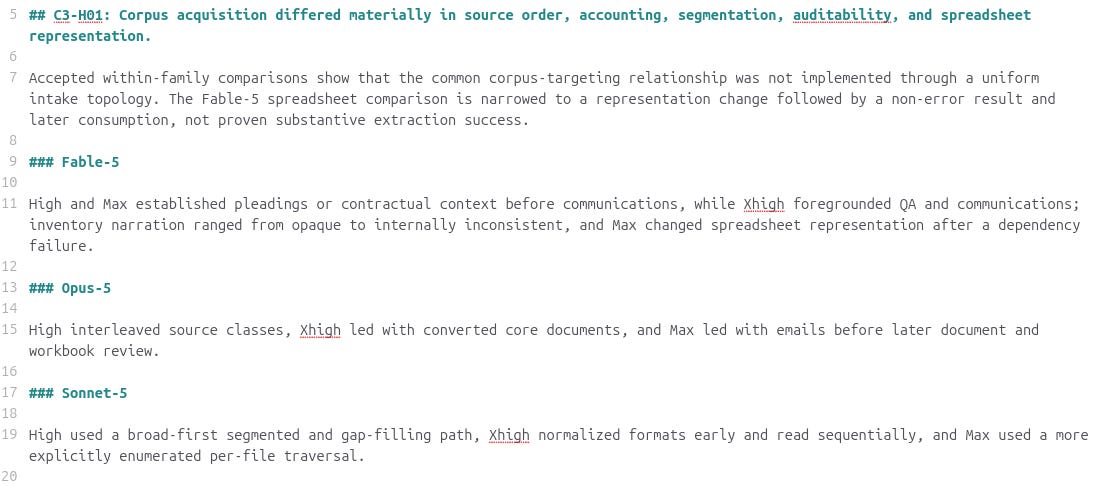
Here, model- and effort-level manifestations are recorded in both characteristic descriptions (C3-G01 and C3-H01).
Each behavior in the analysis rests on one or more session trajectories. Task-level behaviors are derived from three model-level profiles, model-level behaviors from three session-level profiles, and session-level behaviors from session trajectories. The results below present task-level profiles for the twelve evaluated tasks.
Results: Recurring Behaviors for the Twelve Evaluated Tasks
The results below present, for each of the twelve tasks, the behaviors that recurred across Fable-5, Opus-5, and Sonnet-5.4 The behavioral differences recorded for each task, and deeper task-specific analysis, will follow in subsequent articles.
Analyze EU AI Act (AI governance)
Recurring behaviors
C3-G01: Each model family prepared the nominal supplied corpus, issued retrievals covering its visible sources, and explicitly continued the token-capped legal-summary read.
C3-G02: Each model family materialized the requested memo through recorded file operations and received creation, non-error, or mechanical verification metadata before delivery.
C3-G03: Across all observed efforts, each model family completed the visible task in one registered parent stream without a visible subagent dispatch-return relationship.
Triage Vendor AI Contracts for Compliance with EU AI Liability Directive (AI governance)
Recurring behaviors
C3-G01: Across the observed sessions, each model family established readable working representations of the office-format inputs before substantive source review.
C3-G02: Across the observed sessions, each model family attempted pre-draft acquisition across the framework, portfolio and incident context, and the supplied agreements.
C3-G03: Across the observed sessions, the parent stream retained task-level coordination and final synthesis and delivery responsibility.
C3-G04: Across the observed sessions, each model family externalized a substantial initial memo through a visible creation operation after source review.
C3-G05: Each model family exhibited an explicit post-create artifact check in at least one observed effort before delivery.
Master Service Agreement, Counterparty Review 03 (commercial)
Recurring behaviors
C3-G01: Registered task execution remained within one parent stream without visible delegation or cross-stream result integration.
C3-G02: Before formal output creation, the workflow prepared readable working materials and accessed principal, contextual, and ancillary sources.
C3-G03: When long-source access was capped or rejected, the workflow issued follow-up requests that continued or repartitioned the affected source.
C3-G04: The redline and memorandum were maintained as separate deliverables and created through serialized formal output operations.
SaaS API Subscription, Counterparty Review 04 (commercial)
Recurring behaviors
C3-G01: The workflow prepared the mixed-format source package and visibly traversed the identified source categories before deliverable drafting.
C3-G02: The workflow treated redline and memo production as successive artifact phases, completing one visible production phase before transitioning to the other.
C3-G03: Final synthesis, deliverable construction, and delivery remained centralized in the registered parent stream.
C3-G04: Before delivery, the workflow performed at least one explicit integrity-oriented check connected to the source package or generated artifacts.
Draft Diligence Summary Memo (corporate)
Recurring behaviors
C3-G01: Across all three model families, the retained record places observed task activity in registered parent streams and contains no accepted direct finding of subagent dispatch or return.
C3-G02: Across all three model families, the workflow inventoried the seven-file mixed-format package, produced locally readable representations, and accessed representations spanning the supplied source categories before memo creation.
C3-G03: Across all three model families, the workflow adjusted local source-handling operations after an intermediate access or output condition and continued toward synthesis.
C3-G04: Across all three model families, the workflow externalized a substantial initial memo after source review and proceeded to delivery.
Review Commercial Contracts Diligence 01 (corporate)
Recurring behaviors
C3-G01: Across all three model families on this task, the workflow created or used tool-readable source representations and visibly accessed planning, correspondence, and contract evidence before memo construction.
C3-G02: Across all three model families on this task, the workflow visibly addressed schedule- or planning-derived assertions or discrepancies through calculation, comparison, or contract-oriented checking before drafting.
C3-G03: Across all three model families on this task, final memo synthesis and file creation remained controlled by the parent workflow after contract-level review.
C3-G04: Across all three model families on this task, the workflow made at least one pre-draft analytical, phase, or progress state observable beyond raw source access.
C3-G05: Across all three model families on this task, the workflow materialized the requested memo as a file and performed at least one post-creation artifact check before delivery.
C3-G06: Across all three model families on this task, at least one visible obstruction or anticipated tool constraint was met by changing the operational tactic and continuing the workflow.
Identify Issues in IP Assignment Agreement (intellectual property)
Recurring behaviors
C3-G01: Across all three model families and retained efforts, the visible workflow inventoried and normalized the enumerated filesystem corpus and obtained returned access records covering every enumerated source before memorandum construction.
C3-G02: Across all three model families and retained efforts, every registered task operation remained in one parent stream without a visible dispatch-return dependency.
C3-G03: Across all three model families and retained efforts, completed visible corpus review preceded a post-review synthesis or construction phase that led to creation of the requested memorandum.
C3-G04: Across all three model families, delivery occurred without a visible post-creation substantive comparison of the completed memorandum against the source corpus.
Compare Asserted Patent Claims to Accused Product (intellectual property)
Recurring behavior
C3-G01: Across all three model families and released efforts, the visible workflow accessed each of the six named source files before the initial artifact Write.
C3-G02: Across all three model families and released efforts, visible task execution remained within the sole registered parent stream without delegation, dispatch, or subagent return.
C3-G03: Across all three model families and released efforts, the requested artifact was first materialized through one visible whole-file Write after access to the six named sources.
C3-G04: Across all three model families, Xhigh’s initial artifact Write was smaller than both High’s and Max’s in recorded characters and recorded lines.
Draft Deposition Outline (litigation)
Recurring behaviors
C3-G01: Across the observed effort sessions, each model family staged broad mixed-format evidence acquisition before the recorded artifact-writing operation and used format-responsive access paths.
C3-G02: Across all three model families and effort sessions, registered task execution remained in one parent stream without visible subagent dispatch or return linkage.
C3-G03: Each model family explicitly created the requested file artifact through recorded mutation operations before delivery.
C3-G04: Across all three model families, post-create assurance was visibly effort-conditioned: every family exposed a structural check in at least one effort, but no family exposed one uniform assurance implementation across all efforts.
C3-G05: Each model family used visible process text to mark a transition from evidence work toward drafting or another ensuing workflow phase.
Build Litigation Case Timeline (litigation)
Recurring behaviors
C3-G01: The workflow targeted the evident mixed-format source corpus through format-adapted, text-oriented access before artifact production.
C3-G02: When a visible source-access or execution complication occurred, the workflow changed method or resumed and continued toward artifact production.
C3-G03: The workflow moved from source review into artifact production at the requested destination and then issued a delivery-shaped assistant response.
C3-G04: Each model family has an observed effort session in which artifact creation was followed by a recorded output-confirmation step before delivery.
C3-G05: All registered task-directed execution remained in one parent stream without a visible dispatch-return dependency.
Analyze CPRA Compliance Gaps Against Current Privacy Program (privacy)
Recurring behavior
C3-G01: Before drafting, each model family prepared a broad working set from the heterogeneous local corpus and continued retrieval when binary incompatibility, truncation, or oversized output impeded direct access.
C3-G02: Across all three model families, observable task execution remained in the sole registered parent stream without a visible subagent dispatch or return.
C3-G03: In every model-family profile, visible corpus review preceded creation of the memo artifact.
C3-G04: Within every model family, Max exposed a more extended persisted-artifact lifecycle than High and Xhigh, through incremental assembly, an added post-write control phase, or both.
Privacy Addendum, Counterparty Review 04 (privacy)
Recurring behavior
C3-G01: Across all three model families, the observed workflows prepared and consulted multiple source categories and continued token-capped reads before drafting.
C3-G02: Across all three model families, major workflow phases were made externally visible during execution before terminal delivery.
C3-G03: Across all three model families, the first persisted redline preceded persistence of the companion memo.
C3-G04: Across all three model families, registered task work remained in a sole parent stream in the observed High and Xhigh sessions.
C3-G05: Each model family exhibited explicit terminal-stage mechanical or structural checking of both requested deliverables in at least one observed effort session.
The twelve tables above present the behaviors that recurred across all three models (Fable-5, Opus-5, and Sonnet-5) on each of the evaluated tasks. The details of these recurring behaviors, along with the behavioral differences recorded in the task, model, and session profiles, will be presented in subsequent analyses and published to GitHub.
Conclusion: The Future of Behavioral Analysis
This article introduces an analysis of legal AI behavior. Rather than analyzing legal AI results, behavioral analysis assesses how those results were produced. Characterizing model, effort, and session behaviors on a particular task may identify the best model and effort for that task. Additionally, skills can be analyzed for their influence on model behavior and tailored to improve it. Finally, combined with results, behavioral analysis may improve legal AI assessment and benchmarking. The recurring behaviors reported here are the baseline. Questions of optimization, skills, and integrated grading will be taken up in future articles.
This analysis is for educational and informational purposes only. It is not legal, financial, or other professional advice and does not create an attorney-client or any other professional relationship. The analysis is based solely on publicly available information. Any views expressed are solely those of the author in the author’s individual capacity.
In order to overcome the generation of multimodal outputs with non-text artifacts (e.g., flowchart images) that are difficult to judge, all task runs were modified to request a markdown deliverables (e.g., litigation-case-timeline.md) in place of office documents (e.g., litigation-case-timeline.docx).
The Legal Agent Benchmark was accessed on July 23, 2026, at https://github.com/harveyai/harvey-labs (commit 845a088) under the open-source MIT license. (Harvey LAB: The Legal Agent Benchmark v1.0, Harvey AI, 2026). The author is not affiliated with Harvey, Anthropic or any AI entity. This article is derived from the author’s personal study of the LAB in support of their own efforts to build, evaluate, and improve AI pipelines for legal analysis.
The Twelve-Task Claude-for-Legal Benchmark matches twelve CfL skills with the Harvey LAB tasks that best exercise those skills. This article assesses only native model behavior; subsequent articles will analyze the behavioral effect of the twelve CfL skills relative to that baseline.
Note that these results are AI-generated because they are drawn directly from AI-supported behavioral analyses of AI models.